Question asked by Chris at breakfast this morning:
“Do you remember that time we had lunch in Singapore?”
The answer, of course, was yesterday. We pulled over for a pit stop in Singapore for gas, a Slurpy, some twinkies and beef jerky, and a bathroom break. Well, we just stopped for refueling, but were right off the Singapore skyline and got our passport stamped even though we weren’t allowed off the ship. Which really sucks, by the way. What a tease.
Otherwise, god, I love this. One of the most surreal elements of SAS is the fact that as vast as the ocean appears to be from the seventh floor deck, the world feels as small as the big map posted in the hallway denoting where we have been. There’s a feeling of, “Hey, wanna go to New Zealand?”, and we can do that. I “just” happens.
Another reason I love being on the ship. Here’s an announcement taken verbatim from our Dean’s Memo.
“Pirates still do exist, although they probably do not look like the one we see in Hollywood movies. There are reports of pirating on the seas throughout the world, oftentimes when a ship is traveling close to land like in the Malacca Strait, which we are about to enter. Although the risk is low the ship does take precautions, like increasing our speed through the area of risk. Pirates are much more interested in cargo ships, not passenger ships.”
Any job that warns you about the danger of pirates can’t be all that bad. Can it?
I reread my final India entry, and reread my journal, and I still don’t think I’ve quite conveyed my experience there quite accurately. I had a long discussion with Janet Eastman, who is teaching journalism on board and writes for the LA Times, about our thoughts and experiences there, and neither of us have quite nailed it yet. India is a difficult country. My journal makes it seem that I jumped out of an airplane, with sensory overload, but yet I feel somewhat removed from that ten days later. But I thought about it a little further, and I’m not sure if simplifying the experience to an intellectual exercise is accurate. I also wanted to emphasize that I loved my five days there. I just wish I could have come up with a better understanding in those five days.
I have lots of pictures to upload, but as Internet is quite slow again, so I’ve only uploaded the Rinspirator picture:
http://www.executiveranch.net/sas/india/rinspirator.jpg
(Speaking of pictures, I guess the link I put up to Chris’s Mauritius pictures didn’t work, so just go directly to his main site and click on “Mauritius” (http://www.37thframe.ca/sas) and Myanmar because I hung out with him the first full day there.)
But India takes us to Myanmar. Semester at Sea had sent trips to Myanmar from other port stops, but this was the first time that the ship would “birth” (cool maritime lingo) in the country. But this would not be without controversy. Myanmar has one of the worst records of human rights violation by the government, second only perhaps to North Korea, and culminating with the house arrest of the 1991 Nobel Peace Prize winner Aung San Suu Kyi, who is still in custody to this day. Desmond Tutu called her his hero and said there is a poster of her up in his office.
The country has the worst possible diplomatic relationship with the United States and still be recognized as a country, and in defiance of the Myanmar government, the U.S. will refer to the country as Burma in its official documents.
(This leads us to our first dilemma – how do we refer to the country when we’re there? I decided that the US government should indeed call it Burma as a symbolic gesture against the government, but when talking to the locals, “Burma” is a vestige of British colonialism and only encompasses the Burmese people, which is only about two-thirds of the population. Myanmar means “Strong People” so the locals seemed to prefer that. Alas).
There is a US diplomatic staff in Myanmar, but, in a move filled with symbolism, there is no U.S. Ambassador there. We have been told that the embargo against the country is the foreign relations issue with the largest bipartisan support of any issue in the US Congress. My OMHML, Archbishop Tutu, is the world’s most ardent opponent of the Myanmar regime and a huge supporter of sanctions in the country.
A very serious dialogue started on the ship. Should we be going to Myanmar? The answer from the Institute of Shipboard Education’s side seemed pretty straightforward – this is an educational trip, and ISE will not put itself in the position to making a political statement by choosing not to go to a country. They’d been to Communist China before they opened their doors to the west, to Vietnam, Cuba, and apartheid South Africa, all in the name of education.
But that still wasn’t reason enough for me to exit the ship. Would our visit be perceived as some sort of endorsement of the government, and would our money end up in the hands of government to be used for more human-rights violations? Should we stay on the ship as some sort of protest? If I decide to not stay on the ship, would that be perceived as some sort of ignorance or indifference to these issues. Coming from India and South Africa, where there was a history of systematic injustices, these were questions that were laying quite heavily with a lot of people.
(By the way, I think this opportunity to compare so many countries in a short amount of time is the most important aspect of SAS, and have a lot to say about it, so I’m sure I’ll come back to this at the end of the voyage).
The answer, for many of us, came when the Kevin McGrath and his wife Olga, our Myanmar Interport Lecturers, boarded the ship in Chennai. He was an UN officials in Burma (and many other countries) for many years, and he built a very convincing case that the sanctions are not working at that they are the wrong approach to dealing with the country (actually, he made the case that sanctions are generally a bad way to deal with international issues, South Africa being a notable exception). Some of the main points, as I understood it:
1. In a country where the ruler believes in Karma, suffering is caused by some greater cosmic force - if my people suffer because of the economic sanctions, then it was meant to be. There’s little motivation to do anything about it. But the government can continue to splurge whatever is left on itself, which means Myanmar has the world’s most disproportionate ratio between military spending to social spending (something like 9 to 1). The ruler isn’t afraid to make insane rulings on the basis of astrology: in the early nineties, the government decided that the money needed to be based on the number 9, and the financial system lost its credibility and collapsed when certain bill denominations were deemed illegal overnight.
2. The sanctions only bring Myanmar closer to China, who fills in the void left by the sanctioning countries. It seemed like all of the major businesses, such as hotels, were owned by Chinese (and Thai) companies. This very close relationship with China is very much against the interest of the United States.
3. The government somewhat fills in the void of services that were missing before by becoming a middleman, taking in the profit, and making services too expensive for the little guy to afford.
4. Keeping Myanmar isolated keeps it away from our consciouness, since there is absolutely little motivation to learn about the human-rights violations in the country if we don’t foster some sort of business or tourist interest there. Sad but true.
5. The conditions in South Africa, under which sanctions worked, was very different from Myanmar. South Africa had a large white middle class, without a despot, which was heavily hurt by the sanctions. South Africa was also surrounded by countries that disapproved of the government, whereas Myanmar is surrounded by friends who can fill a lot of the holes created by the sanctions.
The conclusion: the country has declined tremendously in the last 10+ years, with severe poverty and on the brink of an AIDS epidemic, yet the government has not changed its human-rights record. So the sanctions aren’t working.
What can we do about it, then? Kevin and Olga have a lot of suggestions, and I hope I get a chance to talk to them about it before they leave us in Vietnam.
Wow, it’s been a while since I’ve written anything remotely academic! (Not that this counts, but, woohoo!) I just realized I vented all this on Myanmar without a word about what happened off the ship… I guess it’s been on my mind a lot. Or I just like venting. Hope you enjoyed it – I’ll post this entry, then start write about fun stuff.
Friday, November 04, 2005


Wednesday, November 02, 2005
The India 500
Hello from the Strait of Malacca! We’re passing by Thailand, sailing past some of those famous Thai islands (Thaislands?). A number of people threatened to jump off the ship and swim ashore. Soon we’ll have Sumatra on one side and Malaysia on the other on our way to Singapore, where we will dock for refueling. We won’t be able to leave the ship. Well, legally anyway.
It’s been a while since India was in our consciousness, but the memories are still pretty fresh. The highlight of the Varanasi trip was boarding the boat that morning on the Holy River Ganges (our guide always referred to the river as such). Just as amazing as seeing the bodies, dead or alive, in the water, was seeing the vendors that came up to you on boats and tagged along to you remora-style. One of the peddlers was selling DVDs of Varanasi and actually had a working television set playing the DVD aboard the little boat.
We left the boat and toured Varanasi on foot, getting close and personal to the funeral pyres, dodging cows along the narrow alleyways, and visiting the Golden Temple, the holiest temple in Hinduism, with a steeple (?) made of solid gold and monkeys jumping all over the place. What was most interesting to me was the mosque next door, with its 30 foot fences and hundreds of military police guards. The mosque was put in the place of an important Hindu temple that was destroyed during the last of many Muslim invasions in India, and now there are many people who want to tear down the mosque and turn it back to a Hindu temple.
The security was simply a microcosm of the immense tension between the Muslims and Hindus in that part of the world. As I alluded to earlier, this is the greatest threat to world peace, more so that the Israeli-Palestinian or the US conflicts as there are two nuclear powers (India and Pakistan) with a history of three wars between themselves in the last fifty years, compounded by possible line of command issues as to who has actual control of that launch button. Few people know how close we were to nuclear war when tensions escalated in 1999 or so (and the more we study it, the more I’m impressed at how thoughtfully and firmly the Clinton administration dealt with the issue). And as the bombings in Delhi (where we were) proved to us last week, the tensions are very, very serious. There are billions of lives at stake here.
Anyway, we get back to the comfort of our hotel, where much to the chagrin of several of us, and to the pleasure of others, they serve us Americanized food. That drove me nuts. Part of the tour involved a tour to a carpet factory, and since I had already done my shopping the previous day, I ditched the group with two girls and we went in search of adventures through the streets of Varanasi.
We are careful not to get hit by the hundreds of honking motorcycles and bicycles and trucks and cars, and eventually make our way in the rain to a village on the very polluted shore of a tributary of the Ganges on the north side of the city. We see some kids playing and we’re curious enough to go down to visit with them, and by the time we get down there, we’re surrounded. The kids are fascinated by these laughing white people dressed in funny clothes, and next thing you know, we’re teaching these very enthusiastic kids how to count to ten in English and I’m doing flips, which means the adults come out as well. I should have taken some video of it, but I did remember to finally pull out the camera before we were out of sight. They were still waving at us when I did so.
One more thing I did in Varanasi – I learned how an ancient loom works while people were gift shopping. Pretty amazing piece of primitive technology. So if you don’t get a gift from India, you can blame it on my morbid fascination for spools of thread. Oh, if I were a cat… them looms are cat-toy heaven… all them hanging spools and stuff…
[Coughing a hairball]
Anyway.
Soon we were out of Varanasi and back in Delhi, which, thanks to those crazy British imperialists, looks a little more western as we know it, though it is the smoggiest city I’ve ever visited. We arrived around 4pm, and the sky was brown on a perfectly cloudless day, and the smog was so thick that we were getting sunset light several hours before sunset – perhaps the ugliest sunset of the voyage.
We went to the largest Hindu temple in Delhi, quite a piece of work. The chanting filled the marble rooms, and in the Krishna section, a very nice old man invited me to sit as he prayed, and regardless of any sort of metaphysical or spiritual significance you attach to prayer or meditation, which I don’t, you can’t deny that it is some pretty soothing and relaxing stuff. Good times.
We also went to a Sikh temple and had to cover our heads to get in. Interesting religion. Relative to the other religions we’ve looked at, I still don’t know much about it, but they seem to steal the pageantry of Islam and the philosophy of Hinduism and seem to be a fairly organized group in India. I took some of their literature to read up a little more on them.
We woke up at 4am after a late night of hanging out and enjoying the World Series (go ‘stros!… sniff…) took off to the crazy Delhi train station and headed for a two-hour trip to Agra.
There really is one reason to visit Agra: the Taj Mahal. We visited two beautiful forts in and around Agra, one of which had the worst and most aggressive peddlers I think we will ever see, and the other which housed the prison of the king that built the Taj, with the view of the Taj down the river, spending all day as we prepared for sunset at our main attraction.
As great as they were, I won’t spend any time describing these forts, because the Taj Mahal is absolutely, positively the most beautiful man-made object I’ve ever seen. (WARNING: CHEESY, FLOWERY, OVER-THE-TOP YET ABSTRACT AND VAGUE LANGUAGE ABOUT TO FOLLOW. I would hate reading myself right now. I’m not kidding. Really, shouldn’t you be working right now? Is that your boss behind you? Should I insert some text about spreadsheets and budgets here? Alright, here it goes…)
Someone should invent a headphone device that plays angelic music every time people set their eyes on the Taj Mahal. I can’t imagine someone building something more beautiful. My first sight of the Taj, from down the river at Fort Agra, was stunning. It is perfect – you can’t stop looking at it. All our pictures from Fort Agra involve views of the Taj, even though the Fort is something to behold itself. When we eventually arrived in the Taj Mahal premises, it was clear that the building had lived up and surpassed all of the hype over the years. In typical Islamic architecture, it is perfectly symmetrical with inlaid black Persian text and artwork on the marble. The flowers and grass and trees and gardens around it are perfectly upkept. There must have been ten thousand tourists there that day, but it never seemed crowded as the marble structure is enormous. People should be required to visit the Taj. The tomb took 22 years to build, and the king was going to build a mirror image of the Taj in black marble across the river but the plan wasn’t completed after he was imprisoned by his own son. Can you imagine what that would have looked like? I know I can’t.
Ok, no more coffee after noon. I promise.
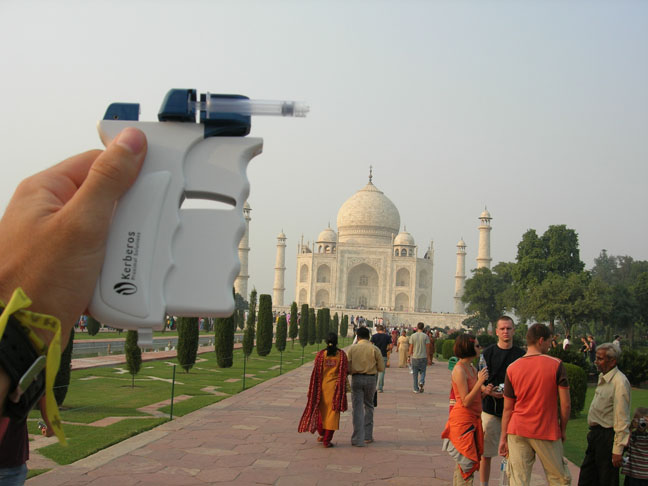
By the way, getting in was an adventure since the place is under heavy security, and I had Kerberos’s Rinspirator™ with me that I promised Tom I would take pictures with around the world. The Rinspirator™ looks like a gun, so try explaining to Indian security what that little device is for. I succeeded – the Taj has been Rinspirated™.
We were there for almost four hours, so after walking around, most of us just picked a spot and watched the sun set on the Taj. Since you’re all sunseted out, I’ll spare the pictures, but I’ll add that I did what must have been the first back flip in Taj Mahal history. Unless you’re talking about the Taj Mahal in Atlantic City, which I hear is just as nice. I’m sure they do back flips over there.
We made our way back to Delhi, but not before we were delayed in the Agra train station at night. The two train stations were quite something, a home for many of India’s most impoverished and disabled beggars. We have been suggested not to give for various reasons, the main one being that if we give, we would do more good by giving to a charitable organization such as the Mother Teresa Foundation. But it doesn’t mean it doesn’t affect you. So you do what you can, and as we had well over an hour delay in the station, we would play with the kids, and no matter where you are in the world, a little juggling or a magic trick goes a long way. At one point, I started to chase the kids in a handstand, which elicited the same response as the when I chased the Pemon Indians in Venezuela, but if you saw the ground of the train station, you would agree with me when I say it was the most disgusting thing I’ve ever done. Well-worth it, but disgusting; though nothing a little bottle of Purell, a liter of bottled water, some grossed-out looks, and another bottle of Purell couldn’t take care of.
Back in Delhi, we cleaned up, went to a sheesha (sp?) bar with the students (When in Delhi…), and hung around until the start of the World Series before getting on a flight back to Chennai in the morning. Chennai would subsequently be hit by a .5 meters ( that’s about 18 inches of rain for those of you who don’t habla espanol) and a cyclone the days after we left.
People simply couldn’t stop talking about Indian experience on the ship. Some people were very affected emotionally by it, and some people preferred to stay on the ship our last day in port. I’ve been thinking a lot about my experience, and I guess I prepared a little too much for it, because as amazing and incredible and surreal as it was, I knew that I would see bodies in Ganges. I knew I would see terrible things in the train stations. I knew I would see people defecating in the streets. And I knew I would see the crazy traffic and the billions of people on the streets. Which means I might have made a protective buffer for India, and after immediately having the unknown of Myanmar as a point of reference, I think my experience in India was more intellectual than emotional. Life-changing? Certainly, I think. Not an immediate change, as I was told to expect and as many people on the ship experienced. Probably something a little more gradual, cummulative, as I still think about the experience, particularly Varanasi, the religious tension, my limited understanding of the caste system (which would be another four pages), and the future of the country, every day since. I hope to come back for at least a month next time. Because I will come back.
The digiweb is slow, so I’ll upload some pictures next, but in the meantime, check out Chris’s Mauritius pictures at http://www.shutterfly.com/progal/album.jsp?pg=2. (Hi Nicolle!) Starting with the pictures of me jumping over – gasp – another sunset, go a couple pages and you can get a sense of our excursion.
That's our wild tour of India in a nutshell. Next up: Myanmar.
It’s been a while since India was in our consciousness, but the memories are still pretty fresh. The highlight of the Varanasi trip was boarding the boat that morning on the Holy River Ganges (our guide always referred to the river as such). Just as amazing as seeing the bodies, dead or alive, in the water, was seeing the vendors that came up to you on boats and tagged along to you remora-style. One of the peddlers was selling DVDs of Varanasi and actually had a working television set playing the DVD aboard the little boat.
We left the boat and toured Varanasi on foot, getting close and personal to the funeral pyres, dodging cows along the narrow alleyways, and visiting the Golden Temple, the holiest temple in Hinduism, with a steeple (?) made of solid gold and monkeys jumping all over the place. What was most interesting to me was the mosque next door, with its 30 foot fences and hundreds of military police guards. The mosque was put in the place of an important Hindu temple that was destroyed during the last of many Muslim invasions in India, and now there are many people who want to tear down the mosque and turn it back to a Hindu temple.
The security was simply a microcosm of the immense tension between the Muslims and Hindus in that part of the world. As I alluded to earlier, this is the greatest threat to world peace, more so that the Israeli-Palestinian or the US conflicts as there are two nuclear powers (India and Pakistan) with a history of three wars between themselves in the last fifty years, compounded by possible line of command issues as to who has actual control of that launch button. Few people know how close we were to nuclear war when tensions escalated in 1999 or so (and the more we study it, the more I’m impressed at how thoughtfully and firmly the Clinton administration dealt with the issue). And as the bombings in Delhi (where we were) proved to us last week, the tensions are very, very serious. There are billions of lives at stake here.
Anyway, we get back to the comfort of our hotel, where much to the chagrin of several of us, and to the pleasure of others, they serve us Americanized food. That drove me nuts. Part of the tour involved a tour to a carpet factory, and since I had already done my shopping the previous day, I ditched the group with two girls and we went in search of adventures through the streets of Varanasi.
We are careful not to get hit by the hundreds of honking motorcycles and bicycles and trucks and cars, and eventually make our way in the rain to a village on the very polluted shore of a tributary of the Ganges on the north side of the city. We see some kids playing and we’re curious enough to go down to visit with them, and by the time we get down there, we’re surrounded. The kids are fascinated by these laughing white people dressed in funny clothes, and next thing you know, we’re teaching these very enthusiastic kids how to count to ten in English and I’m doing flips, which means the adults come out as well. I should have taken some video of it, but I did remember to finally pull out the camera before we were out of sight. They were still waving at us when I did so.
One more thing I did in Varanasi – I learned how an ancient loom works while people were gift shopping. Pretty amazing piece of primitive technology. So if you don’t get a gift from India, you can blame it on my morbid fascination for spools of thread. Oh, if I were a cat… them looms are cat-toy heaven… all them hanging spools and stuff…
[Coughing a hairball]
Anyway.
Soon we were out of Varanasi and back in Delhi, which, thanks to those crazy British imperialists, looks a little more western as we know it, though it is the smoggiest city I’ve ever visited. We arrived around 4pm, and the sky was brown on a perfectly cloudless day, and the smog was so thick that we were getting sunset light several hours before sunset – perhaps the ugliest sunset of the voyage.
We went to the largest Hindu temple in Delhi, quite a piece of work. The chanting filled the marble rooms, and in the Krishna section, a very nice old man invited me to sit as he prayed, and regardless of any sort of metaphysical or spiritual significance you attach to prayer or meditation, which I don’t, you can’t deny that it is some pretty soothing and relaxing stuff. Good times.
We also went to a Sikh temple and had to cover our heads to get in. Interesting religion. Relative to the other religions we’ve looked at, I still don’t know much about it, but they seem to steal the pageantry of Islam and the philosophy of Hinduism and seem to be a fairly organized group in India. I took some of their literature to read up a little more on them.
We woke up at 4am after a late night of hanging out and enjoying the World Series (go ‘stros!… sniff…) took off to the crazy Delhi train station and headed for a two-hour trip to Agra.
There really is one reason to visit Agra: the Taj Mahal. We visited two beautiful forts in and around Agra, one of which had the worst and most aggressive peddlers I think we will ever see, and the other which housed the prison of the king that built the Taj, with the view of the Taj down the river, spending all day as we prepared for sunset at our main attraction.
As great as they were, I won’t spend any time describing these forts, because the Taj Mahal is absolutely, positively the most beautiful man-made object I’ve ever seen. (WARNING: CHEESY, FLOWERY, OVER-THE-TOP YET ABSTRACT AND VAGUE LANGUAGE ABOUT TO FOLLOW. I would hate reading myself right now. I’m not kidding. Really, shouldn’t you be working right now? Is that your boss behind you? Should I insert some text about spreadsheets and budgets here? Alright, here it goes…)
Someone should invent a headphone device that plays angelic music every time people set their eyes on the Taj Mahal. I can’t imagine someone building something more beautiful. My first sight of the Taj, from down the river at Fort Agra, was stunning. It is perfect – you can’t stop looking at it. All our pictures from Fort Agra involve views of the Taj, even though the Fort is something to behold itself. When we eventually arrived in the Taj Mahal premises, it was clear that the building had lived up and surpassed all of the hype over the years. In typical Islamic architecture, it is perfectly symmetrical with inlaid black Persian text and artwork on the marble. The flowers and grass and trees and gardens around it are perfectly upkept. There must have been ten thousand tourists there that day, but it never seemed crowded as the marble structure is enormous. People should be required to visit the Taj. The tomb took 22 years to build, and the king was going to build a mirror image of the Taj in black marble across the river but the plan wasn’t completed after he was imprisoned by his own son. Can you imagine what that would have looked like? I know I can’t.
Ok, no more coffee after noon. I promise.
By the way, getting in was an adventure since the place is under heavy security, and I had Kerberos’s Rinspirator™ with me that I promised Tom I would take pictures with around the world. The Rinspirator™ looks like a gun, so try explaining to Indian security what that little device is for. I succeeded – the Taj has been Rinspirated™.
We were there for almost four hours, so after walking around, most of us just picked a spot and watched the sun set on the Taj. Since you’re all sunseted out, I’ll spare the pictures, but I’ll add that I did what must have been the first back flip in Taj Mahal history. Unless you’re talking about the Taj Mahal in Atlantic City, which I hear is just as nice. I’m sure they do back flips over there.
We made our way back to Delhi, but not before we were delayed in the Agra train station at night. The two train stations were quite something, a home for many of India’s most impoverished and disabled beggars. We have been suggested not to give for various reasons, the main one being that if we give, we would do more good by giving to a charitable organization such as the Mother Teresa Foundation. But it doesn’t mean it doesn’t affect you. So you do what you can, and as we had well over an hour delay in the station, we would play with the kids, and no matter where you are in the world, a little juggling or a magic trick goes a long way. At one point, I started to chase the kids in a handstand, which elicited the same response as the when I chased the Pemon Indians in Venezuela, but if you saw the ground of the train station, you would agree with me when I say it was the most disgusting thing I’ve ever done. Well-worth it, but disgusting; though nothing a little bottle of Purell, a liter of bottled water, some grossed-out looks, and another bottle of Purell couldn’t take care of.
Back in Delhi, we cleaned up, went to a sheesha (sp?) bar with the students (When in Delhi…), and hung around until the start of the World Series before getting on a flight back to Chennai in the morning. Chennai would subsequently be hit by a .5 meters ( that’s about 18 inches of rain for those of you who don’t habla espanol) and a cyclone the days after we left.
People simply couldn’t stop talking about Indian experience on the ship. Some people were very affected emotionally by it, and some people preferred to stay on the ship our last day in port. I’ve been thinking a lot about my experience, and I guess I prepared a little too much for it, because as amazing and incredible and surreal as it was, I knew that I would see bodies in Ganges. I knew I would see terrible things in the train stations. I knew I would see people defecating in the streets. And I knew I would see the crazy traffic and the billions of people on the streets. Which means I might have made a protective buffer for India, and after immediately having the unknown of Myanmar as a point of reference, I think my experience in India was more intellectual than emotional. Life-changing? Certainly, I think. Not an immediate change, as I was told to expect and as many people on the ship experienced. Probably something a little more gradual, cummulative, as I still think about the experience, particularly Varanasi, the religious tension, my limited understanding of the caste system (which would be another four pages), and the future of the country, every day since. I hope to come back for at least a month next time. Because I will come back.
The digiweb is slow, so I’ll upload some pictures next, but in the meantime, check out Chris’s Mauritius pictures at http://www.shutterfly.com/progal/album.jsp?pg=2. (Hi Nicolle!) Starting with the pictures of me jumping over – gasp – another sunset, go a couple pages and you can get a sense of our excursion.
That's our wild tour of India in a nutshell. Next up: Myanmar.
Tuesday, November 01, 2005
Um.
So a while back I asked people on the ship if they would guest blog for me once in a while. “I hang out a lot with Sony,” I thought. “She's hilarious - I’m sure she’ll have a funny story or two for the folk back home.”
I guess I wasn't expecting a work of fiction. Though she did come up with a pretty funny story... if Sony wanted to make me squirm, she succeeded. (This story is actually applicable to David from the Global Nomads).
A little about Sony… she is, hands-down, the best videographer I’ve ever seen at work. She’s shooting the voyage DVD and we had the honor of using her camera work on our fun Olympics video. You can read a little more about our adventures in her blog (http://sonyss.blogspot.com) or the travel articles she writes for GoNomad.
Warts and all. Warts and all...
When he shed his long locks on Neptune Day I cried out "No, not the hair!". When he took off for Salvador solo, I secretly wished I could come with. When he dressed in a longi surely I thought he'd look too feminine to find attractive. But then he had to go and pull out all the stops last night; donning a white-pressed captains uniform with crisp clean cut pants. What's a lonely single girl in the middle of the Bay of Bengal to do with her Brazilian crush on Halloween night? He's well aware of the hypnotic power he wields and works it like bait on a hook. Cunningly tossing a toothy smile and a couple winks my way when his ego needs massaging. Unfortunately, I'm behind a long long line of perfectly shaped 22 year old princesses, all battling for a few precious seconds of Rico's attention. Looks isn't everything though and so surely Rico lacks in other areas, like perhaps personality, charisma or brains? No, no and no again. The angels above crafted yet another man out of most women's reach. But nobody's immortal and so I'm determined to find the weakest link beyond Rico's perfectly polished exterior. What makes this guy squirm? What terrifies him? What or who or when isn't he comfortable? A decade of photographing people has me trained to be more observant than most and so Rico, my beautiful buffed Adonis, your my case-study until the end of the trip. One false move and your mine!
Goo!
I guess I wasn't expecting a work of fiction. Though she did come up with a pretty funny story... if Sony wanted to make me squirm, she succeeded. (This story is actually applicable to David from the Global Nomads).
A little about Sony… she is, hands-down, the best videographer I’ve ever seen at work. She’s shooting the voyage DVD and we had the honor of using her camera work on our fun Olympics video. You can read a little more about our adventures in her blog (http://sonyss.blogspot.com) or the travel articles she writes for GoNomad.
Warts and all. Warts and all...
When he shed his long locks on Neptune Day I cried out "No, not the hair!". When he took off for Salvador solo, I secretly wished I could come with. When he dressed in a longi surely I thought he'd look too feminine to find attractive. But then he had to go and pull out all the stops last night; donning a white-pressed captains uniform with crisp clean cut pants. What's a lonely single girl in the middle of the Bay of Bengal to do with her Brazilian crush on Halloween night? He's well aware of the hypnotic power he wields and works it like bait on a hook. Cunningly tossing a toothy smile and a couple winks my way when his ego needs massaging. Unfortunately, I'm behind a long long line of perfectly shaped 22 year old princesses, all battling for a few precious seconds of Rico's attention. Looks isn't everything though and so surely Rico lacks in other areas, like perhaps personality, charisma or brains? No, no and no again. The angels above crafted yet another man out of most women's reach. But nobody's immortal and so I'm determined to find the weakest link beyond Rico's perfectly polished exterior. What makes this guy squirm? What terrifies him? What or who or when isn't he comfortable? A decade of photographing people has me trained to be more observant than most and so Rico, my beautiful buffed Adonis, your my case-study until the end of the trip. One false move and your mine!
Goo!
Sunday, October 30, 2005
Summers in Rangoon, Luge Lessons
There was one question I was dreading more than any other when I returned home: what was your favorite country? Is it possible to pick, and Jason put it, between riding an elephant, being made leader of a tribe that has never seen a camera before, swimming with whales and learning their language? Can a father choose between his children? This blog, in essence, was a defensive mechanism against that question, so I didn’t have to sum up 100 days of experiences into a simple, “SAS is cool” response.
Then we arrrived in Myanmar.
Perhaps it was the fact that the our ATM and credit cards were useless thanks to the international economic sanctions imposed on that country. Perhaps it was the fear of the totalitarian state – is this what living in Germany in the 1930s was like? Or maybe it was the fact that I had to morally justify a visit to this country when the object of my heterosexual man-lust, Desmond Tutu, is the world’s most ardent opponent of the Myanmar government and told us he would not have joined us had he known we were traveling there (Danno – I would love to talk to Anna Eshoo at some point about why I think sanctions are the wrong approach to dealing with this country….)
But perhaps it was the fact that the white paste that the women and children use on their face elicited more surprise and culture shock to me than the sight of a burning funeral pyre. Or the fact that there are monks all over the place. Or the fact that huge and ancient city ruins - without a lot of tourists - still exist in the world.
Perhaps it was the fact that we just didn’t know what to expect.
All in all, my experience was the utopian ideal of Semester at Sea’s mission. Clearly not everyone had a similar experience. But I imagine that the early Semester at Sea trips into Communist China, Vietnam, Cuba, and apartheid South Africa must have been like. I’ve been waiting to write about it all week – I hope I can convey why I enjoyed this trip so much.
By the way, when researching what I should do in Myanmar before leaving on the ship, I had the hardest time finding people who had been there (I eventually found Brent Schulkin’s uncle who gave me some great suggestions). But turns out my sister Lilian has been here and I had no idea. Who knew?
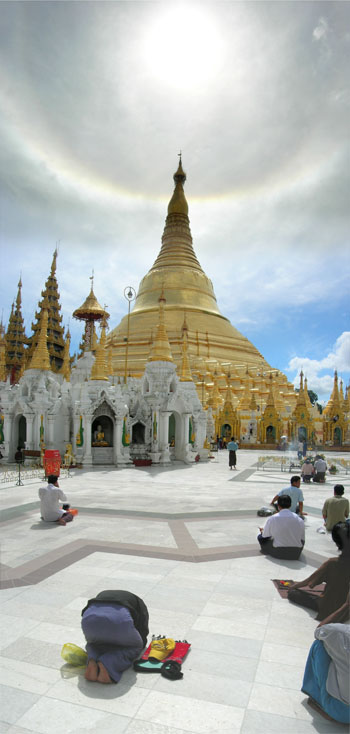
I’ll finish the India report, then write about Myanmar. In the meantime, enjoy this picture – the meterological phenomenon that created a full halo around the Shwedagon Pagoda was one of the most amazing things I’ve ever seen (the halo was a lot brighter in person).
Then we arrrived in Myanmar.
Perhaps it was the fact that the our ATM and credit cards were useless thanks to the international economic sanctions imposed on that country. Perhaps it was the fear of the totalitarian state – is this what living in Germany in the 1930s was like? Or maybe it was the fact that I had to morally justify a visit to this country when the object of my heterosexual man-lust, Desmond Tutu, is the world’s most ardent opponent of the Myanmar government and told us he would not have joined us had he known we were traveling there (Danno – I would love to talk to Anna Eshoo at some point about why I think sanctions are the wrong approach to dealing with this country….)
But perhaps it was the fact that the white paste that the women and children use on their face elicited more surprise and culture shock to me than the sight of a burning funeral pyre. Or the fact that there are monks all over the place. Or the fact that huge and ancient city ruins - without a lot of tourists - still exist in the world.
Perhaps it was the fact that we just didn’t know what to expect.
All in all, my experience was the utopian ideal of Semester at Sea’s mission. Clearly not everyone had a similar experience. But I imagine that the early Semester at Sea trips into Communist China, Vietnam, Cuba, and apartheid South Africa must have been like. I’ve been waiting to write about it all week – I hope I can convey why I enjoyed this trip so much.
By the way, when researching what I should do in Myanmar before leaving on the ship, I had the hardest time finding people who had been there (I eventually found Brent Schulkin’s uncle who gave me some great suggestions). But turns out my sister Lilian has been here and I had no idea. Who knew?
I’ll finish the India report, then write about Myanmar. In the meantime, enjoy this picture – the meterological phenomenon that created a full halo around the Shwedagon Pagoda was one of the most amazing things I’ve ever seen (the halo was a lot brighter in person).
Tuesday, October 25, 2005
Myanmar State of Mind
We’re docked in Myanmar, and it looks like Iowa right now. Somewhere we took a turn into the Mississippi River. With pagodas and locals that wear dresses. This is going to be awesome.
I must apologize for cutting the India report short. I ran out of time with only a 23 hour day to process India and prepare for Burma. I’ll have to write about both between Burma and Vietnam/Cambodia. I wrote 22 pages in my personal journal about India, so maybe I’ll just reprint them here. Here’s an excerpt:
And then the girls said, “Really, why won’t you make out with both of us right now?”
Just kidding. Kind of. I just wanted to see that in print.
Really, I’ll catch up with everything then. A ton of people sent me emails in the last ten days – I’ve read them all but haven’t had time to respond to any of them. But I will when I get back.
We’re in Burma. This is crazy. See you in a few days.
I must apologize for cutting the India report short. I ran out of time with only a 23 hour day to process India and prepare for Burma. I’ll have to write about both between Burma and Vietnam/Cambodia. I wrote 22 pages in my personal journal about India, so maybe I’ll just reprint them here. Here’s an excerpt:
And then the girls said, “Really, why won’t you make out with both of us right now?”
Just kidding. Kind of. I just wanted to see that in print.
Really, I’ll catch up with everything then. A ton of people sent me emails in the last ten days – I’ve read them all but haven’t had time to respond to any of them. But I will when I get back.
We’re in Burma. This is crazy. See you in a few days.
Varamazing
I woke up 2.5 hours ago to watch the sunrise and went back to bed. I’m back, and wide awake! Where are we? In Myanmar about to enter the Aeyerwaddy River (which I incorrectly typed as Yangoon River in the previous entry). But that’s not important right now.
We’re in Varanasi, the holiest city in India, waking up at 4am to go to the shores of the holy river Ganges to watch the early morning religious rituals from a boat. Hindus see the Ganges as a godess, and even though it is a visibly polluted, this doesn’t stop the faithful from bathing and drinking the water, often times just feet away from…
Well, the bus drops us off about a ten-minute walk from the shore, and now I finally hear the sounds of India as we have been taught to hear. A funeral procession – no, a funeral celebration - is going on next to us, and the we pass the dozens of beggars and cows and faithfuls and holy men in our short walk to the shore.
(Allow me to interrupt this for a second – we’re in the river and our first sight of Burma is of completely rural countryside, with straw huts and villages and thousands of small fishing boats all over the place. I swear some of these boats will capsize on our ship’s wake. For the first time on this trip, I feel like we’re the first westerners to see some of this stuff, and in many ways, we probably are).
(This is awesome. I’m going outside for a while).
(Back to India).
We pile on the boats and the sight is something straight out of Star Wars, with buildings and people and colors that could be found in another galaxy. The fires on the funeral pyres light up the crematorium. People have gotten into the water, young and old, mostly clothed, though it was interesting to see that in such a conservative society, that we see very old women naked as they change into dry sarees. As the sun came up over the eastern shore of the river, we had the first up close view of the dead bodies.
(I can see four golden pagodas from where I’m sitting).
This was surreal. There are in fact floating bodies in the Ganges. We saw rotten ones. We saw fresh ones being dumped. Most of the time, people are supposed to be burned in the pyres before their ashes get dumped in the river, but some people, like holy men, those who died of snake bite, and those who can’t afford the cremation simply get dumped in the river. And since there are many faithful who also like to float while quietly meditating, the game “Is he dead or alive?” becomes a really fun game on the boat.
We exited the boat into the crematorium, where we did, in fact, see the bodies get taken into the river for blessing before getting taken to the funeral pyre to be burned. We saw the bodies get burned – one of which only the head remained. They would eventually move the head into the fire for full cremation.
This is as far away and alien as from our society as imaginable (or unimaginable). Yet there was this certain calmness and normalcy about it all. There was no culture shock. There should have been. This all made sense while we were there. This is what they do. They’re not hurting anyone (except perhaps the unhealthy practice of making use of the polluted river). Death is seen as a normal, mundane process in Varanasi; I asked our tour guide if there was mourning of the dead and he said there was momentary sadness in Hinduism, but for the most part, they believe the person has been reincarnated, so murning doesn’t exist as we understand it in the west.
I want to know more about this. I want to spend a month in India. Not to find some truth, but just to learn more as to what their thinking. This is simply surreal, yet so familiar and normal.
Ok, I have to stop now. We keep passing more pagodas and I need to see what is going on outside. It’s as if there are no western influences or modernities where we have been going. This is amazing.
Back in a few.
We’re in Varanasi, the holiest city in India, waking up at 4am to go to the shores of the holy river Ganges to watch the early morning religious rituals from a boat. Hindus see the Ganges as a godess, and even though it is a visibly polluted, this doesn’t stop the faithful from bathing and drinking the water, often times just feet away from…
Well, the bus drops us off about a ten-minute walk from the shore, and now I finally hear the sounds of India as we have been taught to hear. A funeral procession – no, a funeral celebration - is going on next to us, and the we pass the dozens of beggars and cows and faithfuls and holy men in our short walk to the shore.
(Allow me to interrupt this for a second – we’re in the river and our first sight of Burma is of completely rural countryside, with straw huts and villages and thousands of small fishing boats all over the place. I swear some of these boats will capsize on our ship’s wake. For the first time on this trip, I feel like we’re the first westerners to see some of this stuff, and in many ways, we probably are).
(This is awesome. I’m going outside for a while).
(Back to India).
We pile on the boats and the sight is something straight out of Star Wars, with buildings and people and colors that could be found in another galaxy. The fires on the funeral pyres light up the crematorium. People have gotten into the water, young and old, mostly clothed, though it was interesting to see that in such a conservative society, that we see very old women naked as they change into dry sarees. As the sun came up over the eastern shore of the river, we had the first up close view of the dead bodies.
(I can see four golden pagodas from where I’m sitting).
This was surreal. There are in fact floating bodies in the Ganges. We saw rotten ones. We saw fresh ones being dumped. Most of the time, people are supposed to be burned in the pyres before their ashes get dumped in the river, but some people, like holy men, those who died of snake bite, and those who can’t afford the cremation simply get dumped in the river. And since there are many faithful who also like to float while quietly meditating, the game “Is he dead or alive?” becomes a really fun game on the boat.
We exited the boat into the crematorium, where we did, in fact, see the bodies get taken into the river for blessing before getting taken to the funeral pyre to be burned. We saw the bodies get burned – one of which only the head remained. They would eventually move the head into the fire for full cremation.
This is as far away and alien as from our society as imaginable (or unimaginable). Yet there was this certain calmness and normalcy about it all. There was no culture shock. There should have been. This all made sense while we were there. This is what they do. They’re not hurting anyone (except perhaps the unhealthy practice of making use of the polluted river). Death is seen as a normal, mundane process in Varanasi; I asked our tour guide if there was mourning of the dead and he said there was momentary sadness in Hinduism, but for the most part, they believe the person has been reincarnated, so murning doesn’t exist as we understand it in the west.
I want to know more about this. I want to spend a month in India. Not to find some truth, but just to learn more as to what their thinking. This is simply surreal, yet so familiar and normal.
Ok, I have to stop now. We keep passing more pagodas and I need to see what is going on outside. It’s as if there are no western influences or modernities where we have been going. This is amazing.
Back in a few.
I Honk, Therefore I Am.
There is a difference between honking the horn in India versus honking the horn in the United States. In the US, one could argue honking is an offensive move – one that tells your opponent, “Get out of my way!” , or, “I’m coming through!” This was my mindset as I first witnessed the crazy traffic just moments getting off the ship in Chennai, India, where the cars might as well come with a permanently sounding horn. It would certainly save the abuse those buttons suffer from the millions of drivers on the road at any given second.
After several days of experiencing the traffic – the honking, the weaving, the cows all over the road, and the endless games of chicken - I realized that not everyone is in a rush to get anywhere. The honking serves a different purpose in India. It is a statement of affirmation. It says, “I’m here, so please don’t decided to take a sudden turn to your left.” I tells us, “I exist.”
I Honk, Therefore I Am.
Once you come to that simple realization, Indian traffic suddenly becomes much calmer that what first meets the eye. Yes, it is chaotic. Yes, it is statistically unsafe. But yes, there should be thousands more accidents than there actually are. I know we almost hit several incoming vehicles – it was just too close. But really, were we truly ever in any real danger?
We were given five days in India. It doesn’t take a genius to figure out that that isn’t nearly enough time. The 1 billionth citizen of the country was born sometime in the last ten years, and the country is as vast and rich and complex as most continents. But five days was a pretty good start.
We woke up with the usual early morning pre-port sunrise crew, and the first thing we noticed as we arrived Chennai was that the sky and the water were brown. And there was a bad smell; not terrible, but something we hadn’t noticed in any of the previous ports. I won’t lie – I almost couldn’t picture arriving without the sounds of sitars and the site of bazaars in the background, but it really didn’t happen that way. We arrived in a concrete cargo ship port, and our first view of the Indian subcontinent was of industry, as should be expected in one of India’s largest city.
There was no easing into India. Immediately out of the port were the hundreds of rickshaws, the thousands of beggars, and the millions of people. Make no mistake – there is no doubt that India has a billion people. The four cities that I visited – Chennai, Delhi, Agra, and Varanasi – always looked like the end of a great concert at the Fillmore in San Francisco. There are people all over the place. Except they won’t clear up and go home… there will always be people all over the place.
But nevermind that, we had business to take care of. Yas, Jason, and I (and possibly Chris) decided against doing the huge SAS trip in China and have been planning a side trip to the province of Sizchuan, where they have holy mountains and great chicken. We wanted to purchase the tickets online, but the government run Dragon Air didn’t allow for e-tickets, so we would have to go to a travel agency to get that taken care of. With the help of a rickshaw driver that would not leave us alone, we found a travel agency, only to find out that the tickets we wanted were sold out.
Never fear. We improvised. We asked for a map of China, and without knowing anything about anything, we randomly picked a city on the map, Kunming, and asked if they had tickets there. They had exactly three. And they were cheaper that tickets to Sizchuan. Without hesitation, and knowing nothing about Kunming, we made the reservation leaving from Hong Kong. Better yet, the employees at the travel agency were extremely generous and didn’t charge us anything for their time. I’ll let you know more about Kunming when we actually do some research on it. But we’re going, and I can’t wait.
We left the travel agency, and the rickshaw driver had been waiting for us the entire time. He would not leave us alone. So what did we do? We negotiated a price with him, of course, of 25 Rupees a person to take us out the whole day. He accepted, and we crammed into the rickshaw – three people in the back, me sharing a one-person seat with the driver, and the crazy tour of Chennai began.
It was a great day. We drove all over the city, seeing everywhere the poverty that is often isolated in the slums and the favelas and the townships in other countries in the world. We did a little shopping (the driver clearly was getting commission on a few of the expensive, crappy gift shops around town, but that ended as soon as we threatened not to pay), ate great South Indian food (Is that redundant? Iisn’t all South Indian food great?), and went to the huge-yet-sewer-smelling Marina Beach, which was heavily hit by last year’s tsunami and where everyone goes fully clothed and no one wears a swimsuit. It isn’t part of Indian culture.
Then again, what is? At this point, we were well aware of many Indian customs, such as the need to dress conservatively – all SAS guys wore pants and all SAS women wore sleeves and loose clothes (by the way, why do Indian women dress so beautifully, by our standards, yet men are the polar opposite?), the use of the right hand and the disapproval of public displays of affection between the sexes (though it is perfectly acceptable for two straight men to walk hand-in-hand down the street). We did notice that a lot of these customs were only followed by the older generation, and wondered if, with the influx of western culture into the country, if there is going to be a generational schism in India similar to what the US experienced in the 60s.
Anyway.
By the end of the day, our driver had a name, Baboo, and I got to drive the rickshaw while my passengers almost wet their pants. The day was almost over, we went back to the ship (but not before Baboo tripled the price of the ride), and we finagled our way into the welcome reception, hoping it would be as good as the one in Brazil. It was nice, with Indian dance and food, but not nearly as fun as Brazil. Not even close. But it had a great day, I’d already seen many things, some of them sad, some of them different, that I’d never seen before, but I was still waiting for that life-changing experience that people told me I would have in India.
I was sure it would happen at some point. But as I got ready for my 4am wake up call to catch my early-morning flight to Delhi, I was sure my chances of doing so were greatly diminished by having signed up, months ago, to one of the largest SAS trip: a crazy, four day tour of Delhi, Agra, and Varanasi with 69 people. I didn’t want other people being my limiting factor on this trip.
But alas, I had already paid. Most of us fell asleep immediately on the plane, hit Delhi, and got a connecting flight to Hinduism’s holiest city, Varanasi, on the shores of the Ganges river.
Varanasi was a lot different from Chennai. I’d been in India for 24 hours and I could already notice big differences between the north and south of the country, which further emphasized the importance of not assuming that any single experience is representative of all of India.
Varanasi is also important as the birthplace of Buddhism, where Buddha gave his first sermon (on enlightment) in Sarnath. We visited a museum of Buddhist history in India, where I learned that Hindus, with their big and complex belief system, can easily claim Buddhism to be a branch of Hinduism, with Buddha being the ninth reincarnation of Vishnu. Interesting, interesting stuff. Sarnath is in ruins because of the many Muslim invasions that India endured over the years (I’ll come back to the tense relationship between the Hindus and Muslims that has grown in the last few years and is the greatest threat to world peace since both majority-Hindu India and majority-Muslim Pakistan are sitting on nuclear arsenals).
This was my introduction to Buddhism, since we haven’t hit it on the ship yet, but it served as a great buildup to the rest of Asia, which I’m most excited about on this trip.
Alright, sorry for the blabbing. You might notice there are not pictures up yet. Things have gotten busy… plus no one can stop talking about India, which is a pretty time-consuming activity. I’m going to sleep for a little bit, then I’ll continue with the rest of the trip. Looks like these will be long entries.
All four engines are running right now – the ship is crossing the Bay of Bengal at 28 knots per hour. You should see the wake behind the ship. We hit the Yangoon river at high tide in the morning on the way to Yangoon. Of course I’m watching the sunrise, again. I think Myanmar is the country I’ve been most excited about visiting this voyage.
Back in a few.
After several days of experiencing the traffic – the honking, the weaving, the cows all over the road, and the endless games of chicken - I realized that not everyone is in a rush to get anywhere. The honking serves a different purpose in India. It is a statement of affirmation. It says, “I’m here, so please don’t decided to take a sudden turn to your left.” I tells us, “I exist.”
I Honk, Therefore I Am.
Once you come to that simple realization, Indian traffic suddenly becomes much calmer that what first meets the eye. Yes, it is chaotic. Yes, it is statistically unsafe. But yes, there should be thousands more accidents than there actually are. I know we almost hit several incoming vehicles – it was just too close. But really, were we truly ever in any real danger?
We were given five days in India. It doesn’t take a genius to figure out that that isn’t nearly enough time. The 1 billionth citizen of the country was born sometime in the last ten years, and the country is as vast and rich and complex as most continents. But five days was a pretty good start.
We woke up with the usual early morning pre-port sunrise crew, and the first thing we noticed as we arrived Chennai was that the sky and the water were brown. And there was a bad smell; not terrible, but something we hadn’t noticed in any of the previous ports. I won’t lie – I almost couldn’t picture arriving without the sounds of sitars and the site of bazaars in the background, but it really didn’t happen that way. We arrived in a concrete cargo ship port, and our first view of the Indian subcontinent was of industry, as should be expected in one of India’s largest city.
There was no easing into India. Immediately out of the port were the hundreds of rickshaws, the thousands of beggars, and the millions of people. Make no mistake – there is no doubt that India has a billion people. The four cities that I visited – Chennai, Delhi, Agra, and Varanasi – always looked like the end of a great concert at the Fillmore in San Francisco. There are people all over the place. Except they won’t clear up and go home… there will always be people all over the place.
But nevermind that, we had business to take care of. Yas, Jason, and I (and possibly Chris) decided against doing the huge SAS trip in China and have been planning a side trip to the province of Sizchuan, where they have holy mountains and great chicken. We wanted to purchase the tickets online, but the government run Dragon Air didn’t allow for e-tickets, so we would have to go to a travel agency to get that taken care of. With the help of a rickshaw driver that would not leave us alone, we found a travel agency, only to find out that the tickets we wanted were sold out.
Never fear. We improvised. We asked for a map of China, and without knowing anything about anything, we randomly picked a city on the map, Kunming, and asked if they had tickets there. They had exactly three. And they were cheaper that tickets to Sizchuan. Without hesitation, and knowing nothing about Kunming, we made the reservation leaving from Hong Kong. Better yet, the employees at the travel agency were extremely generous and didn’t charge us anything for their time. I’ll let you know more about Kunming when we actually do some research on it. But we’re going, and I can’t wait.
We left the travel agency, and the rickshaw driver had been waiting for us the entire time. He would not leave us alone. So what did we do? We negotiated a price with him, of course, of 25 Rupees a person to take us out the whole day. He accepted, and we crammed into the rickshaw – three people in the back, me sharing a one-person seat with the driver, and the crazy tour of Chennai began.
It was a great day. We drove all over the city, seeing everywhere the poverty that is often isolated in the slums and the favelas and the townships in other countries in the world. We did a little shopping (the driver clearly was getting commission on a few of the expensive, crappy gift shops around town, but that ended as soon as we threatened not to pay), ate great South Indian food (Is that redundant? Iisn’t all South Indian food great?), and went to the huge-yet-sewer-smelling Marina Beach, which was heavily hit by last year’s tsunami and where everyone goes fully clothed and no one wears a swimsuit. It isn’t part of Indian culture.
Then again, what is? At this point, we were well aware of many Indian customs, such as the need to dress conservatively – all SAS guys wore pants and all SAS women wore sleeves and loose clothes (by the way, why do Indian women dress so beautifully, by our standards, yet men are the polar opposite?), the use of the right hand and the disapproval of public displays of affection between the sexes (though it is perfectly acceptable for two straight men to walk hand-in-hand down the street). We did notice that a lot of these customs were only followed by the older generation, and wondered if, with the influx of western culture into the country, if there is going to be a generational schism in India similar to what the US experienced in the 60s.
Anyway.
By the end of the day, our driver had a name, Baboo, and I got to drive the rickshaw while my passengers almost wet their pants. The day was almost over, we went back to the ship (but not before Baboo tripled the price of the ride), and we finagled our way into the welcome reception, hoping it would be as good as the one in Brazil. It was nice, with Indian dance and food, but not nearly as fun as Brazil. Not even close. But it had a great day, I’d already seen many things, some of them sad, some of them different, that I’d never seen before, but I was still waiting for that life-changing experience that people told me I would have in India.
I was sure it would happen at some point. But as I got ready for my 4am wake up call to catch my early-morning flight to Delhi, I was sure my chances of doing so were greatly diminished by having signed up, months ago, to one of the largest SAS trip: a crazy, four day tour of Delhi, Agra, and Varanasi with 69 people. I didn’t want other people being my limiting factor on this trip.
But alas, I had already paid. Most of us fell asleep immediately on the plane, hit Delhi, and got a connecting flight to Hinduism’s holiest city, Varanasi, on the shores of the Ganges river.
Varanasi was a lot different from Chennai. I’d been in India for 24 hours and I could already notice big differences between the north and south of the country, which further emphasized the importance of not assuming that any single experience is representative of all of India.
Varanasi is also important as the birthplace of Buddhism, where Buddha gave his first sermon (on enlightment) in Sarnath. We visited a museum of Buddhist history in India, where I learned that Hindus, with their big and complex belief system, can easily claim Buddhism to be a branch of Hinduism, with Buddha being the ninth reincarnation of Vishnu. Interesting, interesting stuff. Sarnath is in ruins because of the many Muslim invasions that India endured over the years (I’ll come back to the tense relationship between the Hindus and Muslims that has grown in the last few years and is the greatest threat to world peace since both majority-Hindu India and majority-Muslim Pakistan are sitting on nuclear arsenals).
This was my introduction to Buddhism, since we haven’t hit it on the ship yet, but it served as a great buildup to the rest of Asia, which I’m most excited about on this trip.
Alright, sorry for the blabbing. You might notice there are not pictures up yet. Things have gotten busy… plus no one can stop talking about India, which is a pretty time-consuming activity. I’m going to sleep for a little bit, then I’ll continue with the rest of the trip. Looks like these will be long entries.
All four engines are running right now – the ship is crossing the Bay of Bengal at 28 knots per hour. You should see the wake behind the ship. We hit the Yangoon river at high tide in the morning on the way to Yangoon. Of course I’m watching the sunrise, again. I think Myanmar is the country I’ve been most excited about visiting this voyage.
Back in a few.
Sunday, October 23, 2005
While my Sitar Gently Weeps
Now that we’re well into the voyage and I feel I learned to travel, I must admit I was really hesitant about my choice of doing a massive four-city tour in five days in India. I’ve had so much success finding independent trips in our last three ports, and had so much fun in the less-touristy destinations, that the idea of criss-crossing the country with 69 other Semester at Sea kids to India’s greatest tourist trap suddenly sounded really unappealing.
But this is India we're talking about. I went, and between Varanasi and the Taj Mahal I experienced some of the most amazing things I’ve seen, and the trip was absolutely worth it. Since we don’t have a lot of time until the next port, I’ll probably post part of the voyage after I take a long nap tonight (to avoid the “blog books” that Mandy mentioned in the comments for the previous entry… and since she seemed to appreciate getting mentioned a while back, Mandy, this is for you:
(Mandy Mandy Mandy Mandy Mandy Mandy Mandy Mandy Mandy Mandy Mandy Mandy Mandy Mandy Mandy Mandy Mandy Mandy Mandy Mandy Mandy Mandy Mandy Mandy Mandy Mandy Mandy Mandy Mandy Mandy Mandy Mandy Mandy Mandy Mandy Mandy Mandy Mandy Mandy Mandy Mandy Mandy Mandy Mandy Mandy Mandy Mandy Mandy Mandy Mandy Mandy Mandy Mandy Mandy Mandy Mandy Mandy Mandy Mandy Mandy Mandy Mandy Mandy Mandy Mandy Mandy
(Ok, back to the issue at hand).
So I’ll take care of that tonight. And since there is a new internet system on board, I’ll see if I can upload pictures from Mauritius. Two people asked if I had a picture with Desi, but I didn’t take any pictures of him. I did find out other people did, so here’s one of them.
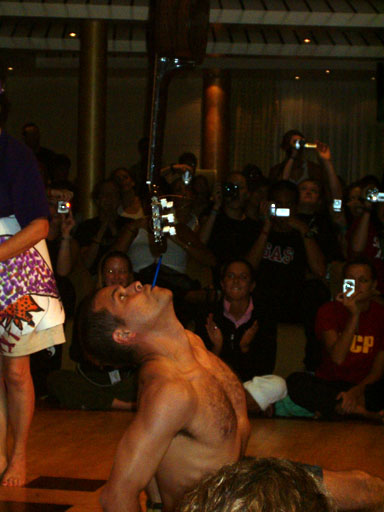
Also, here’s one of me spinning the guitar on the pen during the Sea Olympics. I know there are better pictures out there, I’ll do my best to upload once I get it.
Also, I noticed on the comments that an SAS mom is reading this. Welcome aboard, Clara! I’m very curious how you found out about this site – it’s not really linked to anything… And who is your son/daughter? Tell him/her/it I said hi.
I feel the ship leaving port as we speak. I really need a shower. Next upload should be relatively soon.
But this is India we're talking about. I went, and between Varanasi and the Taj Mahal I experienced some of the most amazing things I’ve seen, and the trip was absolutely worth it. Since we don’t have a lot of time until the next port, I’ll probably post part of the voyage after I take a long nap tonight (to avoid the “blog books” that Mandy mentioned in the comments for the previous entry… and since she seemed to appreciate getting mentioned a while back, Mandy, this is for you:
(Mandy Mandy Mandy Mandy Mandy Mandy Mandy Mandy Mandy Mandy Mandy Mandy Mandy Mandy Mandy Mandy Mandy Mandy Mandy Mandy Mandy Mandy Mandy Mandy Mandy Mandy Mandy Mandy Mandy Mandy Mandy Mandy Mandy Mandy Mandy Mandy Mandy Mandy Mandy Mandy Mandy Mandy Mandy Mandy Mandy Mandy Mandy Mandy Mandy Mandy Mandy Mandy Mandy Mandy Mandy Mandy Mandy Mandy Mandy Mandy Mandy Mandy Mandy Mandy Mandy Mandy
(Ok, back to the issue at hand).
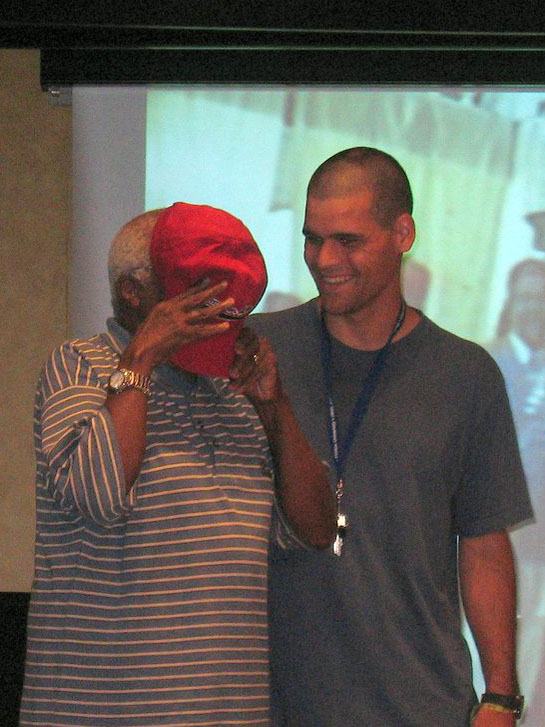
So I’ll take care of that tonight. And since there is a new internet system on board, I’ll see if I can upload pictures from Mauritius. Two people asked if I had a picture with Desi, but I didn’t take any pictures of him. I did find out other people did, so here’s one of them.
Also, here’s one of me spinning the guitar on the pen during the Sea Olympics. I know there are better pictures out there, I’ll do my best to upload once I get it.
Also, I noticed on the comments that an SAS mom is reading this. Welcome aboard, Clara! I’m very curious how you found out about this site – it’s not really linked to anything… And who is your son/daughter? Tell him/her/it I said hi.
I feel the ship leaving port as we speak. I really need a shower. Next upload should be relatively soon.
Wednesday, October 19, 2005
Spring Break Fall '05
Free internet day! The internet has been the biggest headache for everybody on the ship with lost minutes (I lost 3.25 hours I had purchased between Salvador and Cape Town), and they’re switching the whole system in India, so until then, the internet is free. The problem is that EVERYBODY is on – no one is going to class, and many, many students stayed up all night online. Which means the internet is EXTREMELY slow. Result: no pictures in this update. It’ll take all night to upload the text.
Freakin’ IM. Everyone’s on it. Here’s a sample of every conversation, as suggested by Photographer Chris:
John: Hey
Bette: Hey
John: Where are you?
Bette: In the middle of the Indian Ocean. Where are you?
John: That’s cool. I’m in my room.
Bette: That’s cool.
Or, this is becoming more common:
John: Hey
Sandy: Hey
John: Where are you?
Sandy: In my cabin. Where are you?
John: In the Library. I’m coming down.
Sandy: Cool. Let’s make sweet love.
Alright, I made up the last line. Sort of. But we’ve seen a lot of students locate each other on the ship, eating up bandwidth since every single line goes from the ship in the Indian ocean to a Satellite to a server in the United States and back again.
Freakin’ a.
Anyway, before we launch into Mauritius, we just finished the Sea Olympics two nights ago and these two days might have been last two days have been my favorite days on the ship. Every team is called a “Sea” – Red Sea, Mediterranean Sea, Aegean Sea, etc.. grouped by where you live on the ship. The (very old) adult passengers, staff, faculty, and dependents named themselves the Vitamin Sea, and since I control the media on the ship, we started a trash talking war that involved lots of slides coming up in the middle of lectures that involved the eminent dominance of the Vitamin Sea over the rest of the ship. It was a great way to get people into it early, and doggone it, they were into it.
There was an opening ceremony complete with the lighting of the torch (built by my counterpart Allan and I using an overhead projector, a fan, and colored streamers. It looked really cool). Our talent show included the video that I spend way too much time on, but it will now be the final act of the official voyage DVD since the students liked it so much (I hope Transvideo is ok with that…). We might make an extended version of it. We have plenty of great raw footage we can add.
There were many events, such as relay races, "lemonade pong", basketball, tug-o-war, etc... I limited myself to the push-up/pull-up (with Global Nomad David) and synchronized swimming competitions. I haven't worked out much on the ship at all but managed to 76 push ups and 24 pull-ups (1 min rest in between), good enough for third place, I believe. Doing that is soooo hard with the rocking of the ship because there are moments when you are incredibly light (when the ship is sliding down the swell), and then moments you become extremely heavy on the way up. That's usually when most people collapse.
Anyway, since all the old people were on my team, we put together a team of five of the older women on the ship and myself, and prepeared ourselves for the synchronized swimming competition. They went all out - dragon costumes, choreography, and headbands made from (unopened) condoms. The pool is shallow enough so I was going to pull out my best tricks - the apple trick, the balancing of the cans, parallel bars on the pool ladder, and lots of flips.
Because of weather conditions (Monsoon season in India), the competition was moved indoors, and it was hilarious. Everyone dressed appropriately (or inappropriately), and did their routines indoors. Plus, it was televised to the entire ship, so all the crew members saw it as well.
I went crazy with the tricks. I took two 65lb weights from the weight room to use as parallettes, figured out I could spin a balancing guitar on a pen in my mouth, relearned Russian circles on the floor, and the response was much greater the one from the one-arm Kolman surprise at the Alumni meet last year.
Realize that people know I'm a gymnast, but until that point no one had seen any tricks, so this came out of nowhere. I'll let Chris comment on it when he writes the next guest blog. Beth says she mentioned it in her blog, and when I the internet actually works again I'll read what she said. But I had a good time.
Today is also the 50-50 day, the midpoint of the voyage, and so much has happened so fast. This is the lamest thing I'll write this trip, but the ship's really become a community and feels like home. It's always a nice feeling to see the ship when you've been away from port for a few days. And before I came aboard, I thought only the moments off the ship would really "count", but there's an entire life aboard that is pretty significant.
Things get really busy now. We spent most of our days at sea on the first half of the voyage, and now we spend most of our time on land - for example, a week in India is followed by a week in Myanmar with only 1 day on the ship in between. Given how much we do in port, this is crazy. But I'm certainly looking forward to it, especially this India-Myanmar-Vietman/Cambodia stretch.
Before I get back to India, let me talk about Mauritius. Now how did 700+ people end up on an island in the middle of the Indian Ocean that most of them had never heard of a week before? The threat of a pirate or a terrorist attack in East Africa is very real right now, and on a big ship full of American students, we are one of the most clear, visible, and easy targets imaginable. It was the smart decision. But I certainly wish we had gone to Kenya. I was looking forward to going to a majority Muslim country, but since the Global Studies class, (which I love and all faculty, staff, and students are required to take) focused on Kenyan and African subject matter even though we were going to Mauritius, it made for a little sadness that we didn’t make it.
Photographer Chris and I have decided we’ll do our own trip to Kenya someday – he’ll come in on his Canadian passport and I’ll come in on my Brazilian passport. Luckily, they made some time to talk about the island in class and cultural preport lectures, which showed Mauritius is a fascinating country in its own right - an island without original natives, it was populated shortly by Arabs, followed by Portuguese, Dutch, English, and French, with thousands of Hindus migrating to work on the sugar cane fields and Chinese to work in trade. The island has a developed economy not dependent on tourism, and is often cited as a model for peaceful racial relations. As a result, this incredibly diverse population is consisted mostly of French-speaking Hindus. It is a trippy experience. I can only imagine how many places with a million people we don’t know exist around the world – with their own history, culture, economy, etc… and how easy it is to forget other people are out there.
Mauritius is most famous for being the only home of the dodo - a huge flightless bird that was extinct in no time centuries ago since it didn't seem to have the fight or flight instinct in it. People would bonk one on the head and none of the birds would try to get away. What a dodo.
There’s a famous quote by Mark Twain about Mauritius – “You gather the idea that Mauritius was made first and then heaven, and that heaven was copied after Mauritius." I’m sure that was true at some point, but years of foresting and industrialization and dynamite fishing keep it far from being heavenly in most places, but it is still a beautiful place at times. Google "Isle de Cerf" and you'll see what I mean. Again, when I have fast internet, I'll post the pictures.
No one had really made plans on the island, so we decided to wing it and just pick a spot and go. Seven of us on staff decided to go to Grande Baie on the north side of the island, look for a villa, and just stay there. We got a cab driver to get us around, and after a lot of wasted time and negotiation, we got a great deal in Mont Choisy, two apartments for very cheap near the beach. Since I hate just sitting on the beach doing nothing, I took my snorkeling gear and immediately go in the water while the rest of the staff would grab a little sun with a few Mauritian drinks of choice.
I loved my first experience in the Indian Ocean. I've been diving/snorkeling in the Atlantic Ocean my whole life, and I'm pretty familiar with the fauna, which doesn't vary all that much from place to place. Especially in the Carribean. But immediately I saw sea life I'd never seen before, with this interesting fire coral all over the place. There was a lot of damaged coral - a lot - and the landscape wasn't striking at all because of it. But I was more fascinated with the new fish that I didn't care all that much. I was out for a while, managing to go about a mile off shore before coming back.
By the time I came back, the Mauritian beer had taken a hold of the group and things had gotten a little incestuous. Since I didn't feel like getting hit on by older staff members all week, and since Chris has a girlfriend at home, we made our plans to get away the next day. We decided to rent scooters to travel around the island to the nicest beach we knew about, Isle de Cerf.
Thinking it through, there were a LOT of reasons not to rent the scooters, including:
1. Mauritians drive on the left side of the road.
2. I have absolutely no riding experience with motorcycles.
3. Mauritian traffic can be very Indian. In other words, scary.
4. My headlight didn't work. But we didn't know that.
Students, by the way, are not allowed to rent motorized vehicles of any kind. Staff is, but we're supposed to keep it quiet. We thought it through a little more, and once the price tag came out - $18 for the full day with no ID check or collateral - we were sold.
Chris had done this before in other countries, so I asked to follow him. We had a little map of the island and we would guess the routes. I packed my snorkeling gear and he packed all his cameras. As the photographer, he wanted his National Geographic moment, and we found several of them. As soon as something looked cool, we would stop and shoot it. I can't wait to upload them (he might have uploaded them to his site already, which I think is http://37thframe.ca/sas.
We started out a little slow as I gained more confidence in my riding abilities, but soon we stopped in the very non-tourist town of Goodland, which I thought was a perfect combination of Carribean and what I imagine India to be, but with all the text in French. Chris was in his first heaven, with no SAS student in sight. I got some directions to the other side of the country, and then first thing we found ourselves in the middle sugar cane fields and other plantations in the heart of the island. By the way, every place we stopped we made a quick video making fun of the other staffers that they weren't there with us. I'll share those videos when I get back to the US.
The next thing he found to shoot were these old Hindu women picking chili peppers with the Mauritian landscape in the background. They didn't want us there at first, but Chris has done this for years and it was awesome watching him approach and befriend the ladies. He stayed them for a while, not speaking a word in each other's language except for a little of Chris's broken Canadian French, they were fast friends and shot away. We couldn't stop repeating to ourselves, "We're in the middle of island off the coast of Madagascar on the other side of the world picking chili peppers with old French-speaking Indian women."
We rode for hours, stopping to shoot, enjoying the ride, landscape, beaches, people, and Hindu temples. Finally, we arrived on the east side of the island, where Isle de Cerf was located. We paied this guy who assured us a boat ride to the beach with a lunch in between. It was cheap. We locked out bikes, took a ferry through saltwater marshes into a beach where delicious bbq chicken awaited us. Then we went to the beach, where (old) topless European women and several clothed SAS students awaited us. I put my snorkeling gear, Chris shot away, and had a good few hours over there. Our plan - get back with enough time to return the bikes at dawn so we didn't have to ride in the dark. We took the boat back to the mainland and headed back to the north of the country.
Well, turns out the best light for taking pictures is at dawn/dusk, and Chris knew that. He would see something, pull over, look over at me, and tell me with his Canadian accent, "Rico, I have to shoot this." As the sun set on the horizon, there was a man burning a sugar cane field (they do this twice a year), the sky looked beautiful, and ashes were all over the place. He took a camera, I took some video, and he really did have to shoot it. By the time we left, it was pretty dark. And I found out my headlights didn't work.
Crap. I'm riding on the left side of the road with no motorcycle experience in an unfamiliar country around uninviting traffic with nothing to indicate I existed. And we would find these awesome things to shoot. We stopped at a soccer game while the sky was still blue, and I figured out my turn signal was working, so I put it on even though the vespa went "beep beep beep beep beep beep" when I did so. And people thought I was turning, so they wouldn't pass me thinking I'd be out of their way at any time. But better be visible jerk and be alive than an invisible target.
Out of this complete darkness, we see another burning sugar cane field, but this one had men with net trying to catch the animals that would run out of the fire. It was hilarious - of course Chris had to shoot it. And I took more video of it with his still camera.
We made it back safely at 9pm or so. I think we'll always think of that bike ride every time we hear a beep for the rest of our lives.
The rest of the staff was still being incestuous at the villa, and since I really enjoy hanging out with the students, Jason and I left the incestuous staff (Chris went to sleep) and went to the clubs at the island where hundreds of SAS kids were enjoying themselves. We got back at 4:30am, concluding one of my favorite days of this trip.
Amy, the IT coordinator, had reserved a scuba dive for us the next morning. After a little hassle trying to convince the dive shop people to let her dive without her card, we put on our wetsuits (it was surprisingly cold) and made it in the water. Ultimately, Amy said it was the least impressive dive she's ever done, probably because of the damaged coral, but I was so fascinated with the new fish that I had a great time and didn't pay much attention to that. (I got in my usual scuba dive zone - Amy said I didn't make eye contact with her until the end of the dive). I did get to pet a 10 foot green Morray eel, which was awesome (Amy took her camera - I'll upload the picture when the internet...). Their "skin" feels like this slimy silk and is the coolest-feeling thing in the world. They should make pillows out of that stuff.
We got back, met up with Global Nomads Jason and Byron (who lived in Jessica Simpson's house), and hired a driver to take us to the south of the country to see the mountains and temples in that area. This is a lot like what I imagine Hawaii to be - lush, striking volcanic landscape against blue ocean water. The difference is that this area has many Hindu temples, including one with an enormous Shiva statue being built that looks like something out of Lord of the Rings. We hiked up to a temple where wild monkeys were feasting on offerings to Shiva, and the worshiping locals were being so incredibly generous by giving us some of the treats they had prepared. I was a little skeptical at first, but tried them anyway and they were delicious and no one got sick from it.
There are many waterfalls in the area, so the rest of the day involved us visiting them. Where possible, we would go right to the edge of the falls and enjoy the view for a while before hiking back. The only thing we didn't think was all that cool was this much-hyped seven-colored dirt, where hundreds of tourists were taken to see this mound in the middle of the forest. Granted, it is really nice dirt. Some of the nicest I've ever seen, actually. But it's dirt. It's not like the badlands, where the colored dirt fills your line of sight. It is more like someone noticed that Mauritius has really nice dirt, cleared some forest, and charged tourists 60 Mauritian Roupees to see it. But given the giant tortoises they add in for bonus, the $2 admission charge was worth it.
So that was our Mauritian experience. If the beginning of the voyage focused more on introspection, this trip was more all-out good time. Though it made me really, really excited for India. We crossed the equator again, making our way into warmer and more humid territory every day (by the way, we also hit Flatonia - this was the first time I've seen a swell-less sea on this trip).
I'm ecstatic about visiting India. I'm not sure what to expect. I'm waiting for a life-changing experience, since everybody tells me that India overwhelms the senses, but I don't know yet what that means. We've been studying it all week on the ship. We've been covering the carpets to protect from the filth that they've experienced in previous voyages. We've been told again and again of all the precautions needed to leave the country with a healthy stomach. We've been told to prepare psychologically. And we've been told to expect graciousness that can't be found elsewhere in the world. I don't know yet what that means. But I'll have a better idea in a week. I hope.
Rahul and Meg wrote a great essay on their visit to India in the TMTTV. I'd find it, but... anyway, I'm visiting the Delhi, the Taj, and Varanasi - one of the holiest places in India, and I'm waiting to see if it really does change people who go there. Even if it is only a couple of days.
I'll try to do a marathon blog session on our one day on the ship between India and Myanmar, for the "cobosceholics" as Anne calls it. Depending on what I find, it might be therapeutic. Who knows?
May the better half of the voyage begin.
Freakin’ IM. Everyone’s on it. Here’s a sample of every conversation, as suggested by Photographer Chris:
John: Hey
Bette: Hey
John: Where are you?
Bette: In the middle of the Indian Ocean. Where are you?
John: That’s cool. I’m in my room.
Bette: That’s cool.
Or, this is becoming more common:
John: Hey
Sandy: Hey
John: Where are you?
Sandy: In my cabin. Where are you?
John: In the Library. I’m coming down.
Sandy: Cool. Let’s make sweet love.
Alright, I made up the last line. Sort of. But we’ve seen a lot of students locate each other on the ship, eating up bandwidth since every single line goes from the ship in the Indian ocean to a Satellite to a server in the United States and back again.
Freakin’ a.
Anyway, before we launch into Mauritius, we just finished the Sea Olympics two nights ago and these two days might have been last two days have been my favorite days on the ship. Every team is called a “Sea” – Red Sea, Mediterranean Sea, Aegean Sea, etc.. grouped by where you live on the ship. The (very old) adult passengers, staff, faculty, and dependents named themselves the Vitamin Sea, and since I control the media on the ship, we started a trash talking war that involved lots of slides coming up in the middle of lectures that involved the eminent dominance of the Vitamin Sea over the rest of the ship. It was a great way to get people into it early, and doggone it, they were into it.
There was an opening ceremony complete with the lighting of the torch (built by my counterpart Allan and I using an overhead projector, a fan, and colored streamers. It looked really cool). Our talent show included the video that I spend way too much time on, but it will now be the final act of the official voyage DVD since the students liked it so much (I hope Transvideo is ok with that…). We might make an extended version of it. We have plenty of great raw footage we can add.
There were many events, such as relay races, "lemonade pong", basketball, tug-o-war, etc... I limited myself to the push-up/pull-up (with Global Nomad David) and synchronized swimming competitions. I haven't worked out much on the ship at all but managed to 76 push ups and 24 pull-ups (1 min rest in between), good enough for third place, I believe. Doing that is soooo hard with the rocking of the ship because there are moments when you are incredibly light (when the ship is sliding down the swell), and then moments you become extremely heavy on the way up. That's usually when most people collapse.
Anyway, since all the old people were on my team, we put together a team of five of the older women on the ship and myself, and prepeared ourselves for the synchronized swimming competition. They went all out - dragon costumes, choreography, and headbands made from (unopened) condoms. The pool is shallow enough so I was going to pull out my best tricks - the apple trick, the balancing of the cans, parallel bars on the pool ladder, and lots of flips.
Because of weather conditions (Monsoon season in India), the competition was moved indoors, and it was hilarious. Everyone dressed appropriately (or inappropriately), and did their routines indoors. Plus, it was televised to the entire ship, so all the crew members saw it as well.
I went crazy with the tricks. I took two 65lb weights from the weight room to use as parallettes, figured out I could spin a balancing guitar on a pen in my mouth, relearned Russian circles on the floor, and the response was much greater the one from the one-arm Kolman surprise at the Alumni meet last year.
Realize that people know I'm a gymnast, but until that point no one had seen any tricks, so this came out of nowhere. I'll let Chris comment on it when he writes the next guest blog. Beth says she mentioned it in her blog, and when I the internet actually works again I'll read what she said. But I had a good time.
Today is also the 50-50 day, the midpoint of the voyage, and so much has happened so fast. This is the lamest thing I'll write this trip, but the ship's really become a community and feels like home. It's always a nice feeling to see the ship when you've been away from port for a few days. And before I came aboard, I thought only the moments off the ship would really "count", but there's an entire life aboard that is pretty significant.
Things get really busy now. We spent most of our days at sea on the first half of the voyage, and now we spend most of our time on land - for example, a week in India is followed by a week in Myanmar with only 1 day on the ship in between. Given how much we do in port, this is crazy. But I'm certainly looking forward to it, especially this India-Myanmar-Vietman/Cambodia stretch.
Before I get back to India, let me talk about Mauritius. Now how did 700+ people end up on an island in the middle of the Indian Ocean that most of them had never heard of a week before? The threat of a pirate or a terrorist attack in East Africa is very real right now, and on a big ship full of American students, we are one of the most clear, visible, and easy targets imaginable. It was the smart decision. But I certainly wish we had gone to Kenya. I was looking forward to going to a majority Muslim country, but since the Global Studies class, (which I love and all faculty, staff, and students are required to take) focused on Kenyan and African subject matter even though we were going to Mauritius, it made for a little sadness that we didn’t make it.
Photographer Chris and I have decided we’ll do our own trip to Kenya someday – he’ll come in on his Canadian passport and I’ll come in on my Brazilian passport. Luckily, they made some time to talk about the island in class and cultural preport lectures, which showed Mauritius is a fascinating country in its own right - an island without original natives, it was populated shortly by Arabs, followed by Portuguese, Dutch, English, and French, with thousands of Hindus migrating to work on the sugar cane fields and Chinese to work in trade. The island has a developed economy not dependent on tourism, and is often cited as a model for peaceful racial relations. As a result, this incredibly diverse population is consisted mostly of French-speaking Hindus. It is a trippy experience. I can only imagine how many places with a million people we don’t know exist around the world – with their own history, culture, economy, etc… and how easy it is to forget other people are out there.
Mauritius is most famous for being the only home of the dodo - a huge flightless bird that was extinct in no time centuries ago since it didn't seem to have the fight or flight instinct in it. People would bonk one on the head and none of the birds would try to get away. What a dodo.
There’s a famous quote by Mark Twain about Mauritius – “You gather the idea that Mauritius was made first and then heaven, and that heaven was copied after Mauritius." I’m sure that was true at some point, but years of foresting and industrialization and dynamite fishing keep it far from being heavenly in most places, but it is still a beautiful place at times. Google "Isle de Cerf" and you'll see what I mean. Again, when I have fast internet, I'll post the pictures.
No one had really made plans on the island, so we decided to wing it and just pick a spot and go. Seven of us on staff decided to go to Grande Baie on the north side of the island, look for a villa, and just stay there. We got a cab driver to get us around, and after a lot of wasted time and negotiation, we got a great deal in Mont Choisy, two apartments for very cheap near the beach. Since I hate just sitting on the beach doing nothing, I took my snorkeling gear and immediately go in the water while the rest of the staff would grab a little sun with a few Mauritian drinks of choice.
I loved my first experience in the Indian Ocean. I've been diving/snorkeling in the Atlantic Ocean my whole life, and I'm pretty familiar with the fauna, which doesn't vary all that much from place to place. Especially in the Carribean. But immediately I saw sea life I'd never seen before, with this interesting fire coral all over the place. There was a lot of damaged coral - a lot - and the landscape wasn't striking at all because of it. But I was more fascinated with the new fish that I didn't care all that much. I was out for a while, managing to go about a mile off shore before coming back.
By the time I came back, the Mauritian beer had taken a hold of the group and things had gotten a little incestuous. Since I didn't feel like getting hit on by older staff members all week, and since Chris has a girlfriend at home, we made our plans to get away the next day. We decided to rent scooters to travel around the island to the nicest beach we knew about, Isle de Cerf.
Thinking it through, there were a LOT of reasons not to rent the scooters, including:
1. Mauritians drive on the left side of the road.
2. I have absolutely no riding experience with motorcycles.
3. Mauritian traffic can be very Indian. In other words, scary.
4. My headlight didn't work. But we didn't know that.
Students, by the way, are not allowed to rent motorized vehicles of any kind. Staff is, but we're supposed to keep it quiet. We thought it through a little more, and once the price tag came out - $18 for the full day with no ID check or collateral - we were sold.
Chris had done this before in other countries, so I asked to follow him. We had a little map of the island and we would guess the routes. I packed my snorkeling gear and he packed all his cameras. As the photographer, he wanted his National Geographic moment, and we found several of them. As soon as something looked cool, we would stop and shoot it. I can't wait to upload them (he might have uploaded them to his site already, which I think is http://37thframe.ca/sas.
We started out a little slow as I gained more confidence in my riding abilities, but soon we stopped in the very non-tourist town of Goodland, which I thought was a perfect combination of Carribean and what I imagine India to be, but with all the text in French. Chris was in his first heaven, with no SAS student in sight. I got some directions to the other side of the country, and then first thing we found ourselves in the middle sugar cane fields and other plantations in the heart of the island. By the way, every place we stopped we made a quick video making fun of the other staffers that they weren't there with us. I'll share those videos when I get back to the US.
The next thing he found to shoot were these old Hindu women picking chili peppers with the Mauritian landscape in the background. They didn't want us there at first, but Chris has done this for years and it was awesome watching him approach and befriend the ladies. He stayed them for a while, not speaking a word in each other's language except for a little of Chris's broken Canadian French, they were fast friends and shot away. We couldn't stop repeating to ourselves, "We're in the middle of island off the coast of Madagascar on the other side of the world picking chili peppers with old French-speaking Indian women."
We rode for hours, stopping to shoot, enjoying the ride, landscape, beaches, people, and Hindu temples. Finally, we arrived on the east side of the island, where Isle de Cerf was located. We paied this guy who assured us a boat ride to the beach with a lunch in between. It was cheap. We locked out bikes, took a ferry through saltwater marshes into a beach where delicious bbq chicken awaited us. Then we went to the beach, where (old) topless European women and several clothed SAS students awaited us. I put my snorkeling gear, Chris shot away, and had a good few hours over there. Our plan - get back with enough time to return the bikes at dawn so we didn't have to ride in the dark. We took the boat back to the mainland and headed back to the north of the country.
Well, turns out the best light for taking pictures is at dawn/dusk, and Chris knew that. He would see something, pull over, look over at me, and tell me with his Canadian accent, "Rico, I have to shoot this." As the sun set on the horizon, there was a man burning a sugar cane field (they do this twice a year), the sky looked beautiful, and ashes were all over the place. He took a camera, I took some video, and he really did have to shoot it. By the time we left, it was pretty dark. And I found out my headlights didn't work.
Crap. I'm riding on the left side of the road with no motorcycle experience in an unfamiliar country around uninviting traffic with nothing to indicate I existed. And we would find these awesome things to shoot. We stopped at a soccer game while the sky was still blue, and I figured out my turn signal was working, so I put it on even though the vespa went "beep beep beep beep beep beep" when I did so. And people thought I was turning, so they wouldn't pass me thinking I'd be out of their way at any time. But better be visible jerk and be alive than an invisible target.
Out of this complete darkness, we see another burning sugar cane field, but this one had men with net trying to catch the animals that would run out of the fire. It was hilarious - of course Chris had to shoot it. And I took more video of it with his still camera.
We made it back safely at 9pm or so. I think we'll always think of that bike ride every time we hear a beep for the rest of our lives.
The rest of the staff was still being incestuous at the villa, and since I really enjoy hanging out with the students, Jason and I left the incestuous staff (Chris went to sleep) and went to the clubs at the island where hundreds of SAS kids were enjoying themselves. We got back at 4:30am, concluding one of my favorite days of this trip.
Amy, the IT coordinator, had reserved a scuba dive for us the next morning. After a little hassle trying to convince the dive shop people to let her dive without her card, we put on our wetsuits (it was surprisingly cold) and made it in the water. Ultimately, Amy said it was the least impressive dive she's ever done, probably because of the damaged coral, but I was so fascinated with the new fish that I had a great time and didn't pay much attention to that. (I got in my usual scuba dive zone - Amy said I didn't make eye contact with her until the end of the dive). I did get to pet a 10 foot green Morray eel, which was awesome (Amy took her camera - I'll upload the picture when the internet...). Their "skin" feels like this slimy silk and is the coolest-feeling thing in the world. They should make pillows out of that stuff.
We got back, met up with Global Nomads Jason and Byron (who lived in Jessica Simpson's house), and hired a driver to take us to the south of the country to see the mountains and temples in that area. This is a lot like what I imagine Hawaii to be - lush, striking volcanic landscape against blue ocean water. The difference is that this area has many Hindu temples, including one with an enormous Shiva statue being built that looks like something out of Lord of the Rings. We hiked up to a temple where wild monkeys were feasting on offerings to Shiva, and the worshiping locals were being so incredibly generous by giving us some of the treats they had prepared. I was a little skeptical at first, but tried them anyway and they were delicious and no one got sick from it.
There are many waterfalls in the area, so the rest of the day involved us visiting them. Where possible, we would go right to the edge of the falls and enjoy the view for a while before hiking back. The only thing we didn't think was all that cool was this much-hyped seven-colored dirt, where hundreds of tourists were taken to see this mound in the middle of the forest. Granted, it is really nice dirt. Some of the nicest I've ever seen, actually. But it's dirt. It's not like the badlands, where the colored dirt fills your line of sight. It is more like someone noticed that Mauritius has really nice dirt, cleared some forest, and charged tourists 60 Mauritian Roupees to see it. But given the giant tortoises they add in for bonus, the $2 admission charge was worth it.
So that was our Mauritian experience. If the beginning of the voyage focused more on introspection, this trip was more all-out good time. Though it made me really, really excited for India. We crossed the equator again, making our way into warmer and more humid territory every day (by the way, we also hit Flatonia - this was the first time I've seen a swell-less sea on this trip).
I'm ecstatic about visiting India. I'm not sure what to expect. I'm waiting for a life-changing experience, since everybody tells me that India overwhelms the senses, but I don't know yet what that means. We've been studying it all week on the ship. We've been covering the carpets to protect from the filth that they've experienced in previous voyages. We've been told again and again of all the precautions needed to leave the country with a healthy stomach. We've been told to prepare psychologically. And we've been told to expect graciousness that can't be found elsewhere in the world. I don't know yet what that means. But I'll have a better idea in a week. I hope.
Rahul and Meg wrote a great essay on their visit to India in the TMTTV. I'd find it, but... anyway, I'm visiting the Delhi, the Taj, and Varanasi - one of the holiest places in India, and I'm waiting to see if it really does change people who go there. Even if it is only a couple of days.
I'll try to do a marathon blog session on our one day on the ship between India and Myanmar, for the "cobosceholics" as Anne calls it. Depending on what I find, it might be therapeutic. Who knows?
May the better half of the voyage begin.
Sunday, October 16, 2005
Ranch at Sea
Excuses, excuses, excuses. Ok, I know some of you might be waiting for the Mauritius report, but I've been extremely busy on the ship - all while having a good time, of course. Most of you reading this right now know that making the Executive Ranch and MS150-stylevideo clips is one of my favorites things to do in the entire world, and when the staff team was supposed to come up with a skit for the Sea Olympics talent show tonight, I suggested that we take advantage of the five video professionals on the staff and make a five-minute, slick-looking production on the Truman Show-esque premise that Semester-at-Sea is really a motion-control ride and that all the staff and faculty really are actors. Let's just say I haven't slept much the last few days. Though based on the response in the showing tonight, it was worth the effort. I can't imagine how it would have turned out if I had the Ranchmates to help brainstorm and make it happen.
Anyway, as soon as the Sea Olympics are done tomorrow (I'm competing in the pull-up, push-up, and synchronized swimming competitions), I'll immerse myself on the Mauritius report.
Speaking of videos, I was talking to Greg, a former Dutch gymnast on the ship a couple of days ago who mentioned that he was a huge fan of the Stanford Men's Gymnastics video pages, without knowing that we were the ones who developed it from scratch. I was pretty happy to hear how big those sites have gotten.
Yesterday I was officially as far away as San Fran as physically possible on earth, twelve hours ahead of y'all.
Anyway, as soon as the Sea Olympics are done tomorrow (I'm competing in the pull-up, push-up, and synchronized swimming competitions), I'll immerse myself on the Mauritius report.
Speaking of videos, I was talking to Greg, a former Dutch gymnast on the ship a couple of days ago who mentioned that he was a huge fan of the Stanford Men's Gymnastics video pages, without knowing that we were the ones who developed it from scratch. I was pretty happy to hear how big those sites have gotten.
Yesterday I was officially as far away as San Fran as physically possible on earth, twelve hours ahead of y'all.
Subscribe to:
Posts (Atom)